
I shared this post on mastodon a couple days ago:1
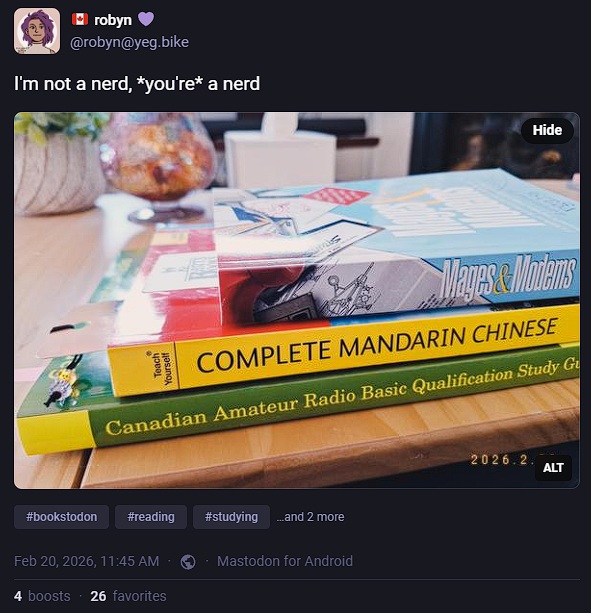
Screenshot of the linked mastodon post, showing a stack of three books. An ALT Text description is available within the mastodon post.
… which reminded me that I had not updated my Now page in a while, so I got to doing that. Once I realized that the Now post had reached the length of a grade five class paper, I moved the .md file over to the main blog posts folder. So: What you are currently reading started as a Now post, then became far too big for its britches, and now here we are.
Learning Something New: A Ham Radio Course!
I have enrolled in a course that preps you for the Canadian Amateur Radio Basic Certification (or it should, anyway, if you apply yourself a lil bit and do some of the rote learning that this requires.) So far, I’ve been having a great time. I know next to nothing about any of the underlying physics, save for what I surely must have learned back in ninth grade, and then promptly forgot. Some thoughts:
Why am I doing this? Isn’t the thrill of “talking to people all over the world” kind of gone in the age of facebook and instagram and discord? And why would we care about frequencies and radios when there is ubiquitous wifi and 5G and I can just unlock my phone to use both?
The more I reflect on it, the more I think it is an underlying interest in non-billionaire-owned, as well as resilient, communication.
Yes, these are “old” methods. They are cumbersome compared to pulling your phone out of your pocket. But: How are you going to communicate if your internet and/or cell towers are ever unavailable? Either because a malicious actor turns them off, or because of simple overload during a disaster (think wildfires or other natural disasters.) The latter can happen at any point depending on where you live (I live in wildfire country), and I think it’s a cool piece of resilience in the face of potential disasters that I may, some day in the future, possibly be able to help someone with communication.
I have also noticed that, while I have a passable understanding of what the components in a computing device do, the difference between your own device and cloud (… someone else’s computer), and while I know my way around Linux distros, have been known to distro-hop, and always have at least four ISO’s flying around on thumb drives to play around with… I have basically no understanding of what happens on the level of the electric current. Or why the heck wifi waves are used for one purpose, and 5G for another. I know resistors exist, but I did not know how they were made, or how the resistance was created, in detail, before I started this course.
Learning ≠ Learning
I necessarily have to do training for work, pretty frequently. But the thing is: That training is either extremely incremental, or it is the kind where really you’re learning nothing new, but have to renew your security training or something else for compliance reasons, that refreshes what you already know.
Even in the case of subject matter training - the first kind - the situation is that I am already a professional in my day job. So what I am learning is a new tool here and there, or a new technique that does something in a slightly different way. This kind of learning does not scratch that same itch. I was ready to get hurt again, in that way that only learning something completely new can hurt you. It is a magical time, to go from absolutely nothing via “I am 1000% never going to understand any of this” to “holy sh*t I actually get it now.” The concept of a Ham education seemed incredibly daunting, and that’s why I did it.
So far, the vibes are good. The community genuinely seems to be excited to welcome newcomers. I was scared as some communities, especially those that have been established a long time ago, can be gate-keepy, but to be fair, any ham enthusiast I had come across online had not been like that either, so. Clearly that was just me being scared of doing something new. And then I did what the old adage says: I did it scared 🙂
The book we use - “The Canadian Amateur Radio Basic Qualification Study Guide” by Coax Publications - feels very accessible. I have felt for many of the concepts that, just from a one-page explanation with illustrations, I was able to grasp them much better than I did in junior high. Granted, I am also a tad older now, but still, the book manages to explain concepts in a concise, clear manner that relates to real-life situations. My understanding is that this book has been around for a long time, and that the authors have improved it continuously based on student feedback. It shows!
There’s also so much content out there to study with - there are many self-guided courses, videos, entire question bank mock exam generators, and buying the aforementioned book gives you access to an entire online resource area.
Maybe Our Junior High Physics Classes Could Have been a Little Better
With all this, I keep thinking back to physics class in junior high and high school, and - surely, if these concepts can be explained so plainly and concisely to someone who hasn’t dealt with questions of atomic structure and electrical currents in decades, we could have also gone about this in a slightly better way in school!? It feels to me like our physics textbooks overcomplicated things. The focus wasn’t on “here’s a real life application” or “here is why a transistor matters,” but on “can you calculate the variables in this seemingly arbitrary formula that has absolutely no bearing on your real life?”
It would certainly also have helped if some of these concepts had been illustrated to us sweaty teenagers by way of devices we were actually using in daily life. By the time I was in middle school, most families had a home computer of some persuasion. Surely there would have been a way to incorporate this into our physics classes on electronics? We were also seeing more and more (what we now call) “dumb phones” (my first one was a Siemens A55 💜,) which surely could have been a vehicle to explain frequencies and signal transmission to us? The only problem: Our textbooks were from the 70s. 🙃 A time when colour TV’s and landline phones were the height of technology. I think. I had to look that up, for I was not alive back then. That said, at school, they didn’t even use those devices to illustrate any of the electronics concepts. It was all diagrams and equations and theory. Dry as day old toast.
I will say, in my physics class’s defense, that at that time, the internet was not yet a thing. We were not yet blessed with the Khan Academys and the Veritasiums of today. Nor were we able to find expertly recorded videos on every single topic of junior high and high school physics within a ten-second web search. Such as, say, the inner workings of an armature generating AC current, which I found immensely helpful, and which made something click.
I also suspect my school was at least a decade behind in terms of multimedia equipment, so if the teacher wanted to show us a documentary (or really anything that had moving pictures in it) in grade eight bio class, he’d wheel in a TV with a VHS player, or use one of those old film projectors that used gigantic tape reels. The ones that wibbled and wobbled while they were played, and had those flashing symbols in the corner when one reel ended.

Our old-timey film projector at school looked somewhat like this, only bigger. Imageby Jeremy Yap on Unsplash.
Today, if I feel like a rendered visualization or a real-life slo-mo recording of a concept could really enhance my understanding of a thing, it is approximately a ten-second internet search away. As opposed to reading static content in a print encyclopedia that was out of the date the moment it left the press, and may or may not also have stemmed from a time when your parents were in school. for a few interesting years, loading up the Encarta from CD-ROM, which you had to have ordered and shipped to your home, was the height of school-related information dissemination and access - but that era didn’t last too long before DSL and Google entered the scene.
Tl;dr, the way they taught us physics back then now feels ancient, and like a great way to kill someone’s interest in A Thing. Now, I want to be very clear that I am not blaming my teachers. They were doing what they could with antiquated infrastructure, old and oftentimes malfunctioning technology, and textbooks that were already over two decades behind, on top of trying to make that all work within the ministry of education-mandated course progression and syllabi. And sometimes I think they were just tired. Which, now that I am adult, I get 100%.
All this to say - despite passing all my physics classes, and most with decent grades, I can’t say I ever had an intuitive grasp of anything covered in them (minus, maybe, optics) - or that anything really stuck around. Which brings me to my next topic…
Re-Learning Something Old: Standard Chinese / 普通话 / “Mandarin”! 2
Sigh. Story time! In the summer of 2008, I got really really bored. So I ended up watching a lot of the Beijing Olympics. Slowly but surely, I grew more interested in the documentaries on Chinese culture and language than the sporting events. So to the bookstore I went, and purchased a Standard Chinese (“Mandarin”) study book that came with audio CD’s. This was a fairly short course, which did NOT teach you how to read and write. (Yes, these are critical, but: Learning how to listen and speak still gives you a leg up over learning nothing at all.)
So anyway, that’s what I did for the rest of the summer. I got to about a CEFR A2 level I’d say, in terms of listening and speaking. Couldn’t read or write a thing, of course. I thought I’d stop there.
在大学 | At University
It turned out, the university I ended up going to had a very decent modern languages department, which also taught Chinese. They had exactly one teacher for Chinese, and ran one class a semester. Naturally, this class would teach you how to read and write Chinese. I thought I’d give it a shot - it wasn’t my major, so what’s the worst that could happen? I was planning on completing one term, and then keeping my options open and potentially dropping it, in case it would be too difficult. I thought I’d stop there.
So along with four other keeners (yes, four), I went and studied Chinese. It quickly became one of my favourite classes. The teacher was phenomenal, as were the study books (that she wrote herself over decades of teaching). She taught us the characters as combinations of radicals, not individual strokes, in a way that made it a lot easier to memorize characters (even today, over a decade later). Being able to pronounce and understand many of the words and phrases we covered in this first semester, plus having a decent understanding of the tonal nature of the language, came in clutch as I was able to spend all that extra time writing and memorizing characters. Repeating words and phrases over and over to myself in the shower over MONTHS had really paid off!
I took another course after, then an additional class on Chinese geography and culture in parallel wth the next class, and then another one, and two years later, I had completed all the courses of Standard Chinese the university had on offer. I thought I’d stop there.
The 汉语水平考试
One fateful afternoon, I learned that the HSK (the 汉语水平考试) was a thing that existed. It is China’s only official Standard Chinese proficiency exam. If you have had to do with standardized English testing before, you can think of it as the TOEFL or IELTS for Chinese. Well, let’s do the first one! How hard can it be. You don’t need to write any characters yet for this one, so I think I can do this.
Hurdle one: The only testing location in my surroundings was over an hour away (that’s nothing in Canadian distances; in European distances, that’s “OH MY GOD that’s your entire day gone.”). I would have to go to “the big city.” Fine. I enrolled, drove down there, went to muji afterwards while I was at it because my town had no such thing as a muji, and passed! Exciting. It meant that I was capable of speaking and reading and understanding lil bb amounts of Standard Chinese. I thought I’d stop there.
Then, the testing location offered HSK II testing. For this one, I weirdly remember that you needed to be able to write a few characters, although any documents I can find outlining the old HSK system (when there were only six levels)3 does not mention writing? It is also possible that I am mixing up my preparations for the HSK 3 exam, which definitely required writing, but which I in the end did not take. I don’t remember. Memory is funny that way.
So anyway, I bought the proverbial book, studied for a bit, and - passed! Exciting. I knew a lil more Chinese. This is where, for now, I did in fact stop. I was eyeballing the HSK 3 exam, and had begun studying for it, but life took me in all sorts of wild directions - I ended up moving continents (not to Asia though!), doing a whoooole lot of grad school, and Chinese fell by the wayside. But it never quite let me go. Anytime I’d see Chinese written somewhere, or heard someone speak it, there were bits and pieces I’d still be able to read and understand.
The Tools
Fast forward to 2026. Duolingo isn’t my cup of tea, so… I did what I always do and bought another book. I’ve always enjoyed the Teach Yourself series - their newest edition is a bit different it seems: They don’t throw you in the deep end anymore with a massive dialogue that you then get to tease apart. I am in chapter 6 (out of 24, I think?) currently, and the new format meant a bit of an adjustment, but I think I like it.
It is truly shocking to me how much of this - how many characters, how much grammar - is clearly still stored somewhere. I would have been able to actively use very little of it in speaking, let alone writing, but I can still read and understand most parts of basic conversations. This is in sharp contrast to remembering what a volt and an ampere actually are - and those are both physical concepts, as oppopsed to hundreds of Chinese characters. I would have assumed the former was stickier in terms of memory than the latter.
Besides the Teach Yourself book and audio files, now available as MP3’s from their online library as opposed to an audio CD way back when, I also use shared Anki decks covering HSK I words and phrases. I think I need to write a separate post about Anki - at this point, customizinig my decks and CSS is one of my favourite pastimes (to the point where I may or may not be studying on occasion, but instead messing with Anki. Sigh).
Thirdly, I use the MDBG Dictionary for all my character, pronunciation, pinyin, translation, radical, and stroke order needs.
But Didn’t you Study Japanese not too Long ago…?
Yes. The problem: All the Kanji came with the Chinese readings in my brain. For free.
Example: 大学, だいがく (daigaku - “university”) in Japanese, took forever for me to “overwrite” in my brain. I would constantly, automatically, read it as dàxué, which is its pronunciation in Standard Chinese. And that’s just one example - this happened for every basic Kanji, as I was liable to have already learned that years before in Chinese. Which meant that I was able to read Hiragana just fine, and then got to a Kanji, and would blurt out its Chinese pronunciation.
Which did three things:
- It resulted in an almost useless Japanese-Chinese hybrid, which really only worked if I was magically speaking to someone who spoke both Japanese and Standard Chinese;
- It made learning Kanji simultaneously easier (“I already know what this means and how to write it!”, minus the fact it often was written the traditional way, not simplified, but when you know the radicals, that’s less of a roadblock); and harder (“I will ilterally never be able to make my brain default to the Japanese reading (or, well, one of many…) for any of these”.)
- It reminded me that Standard Chinese existed and, even more importantly, that clearly a lot of that knowledge was still stored somewhere, just under the surface.
Japanese was very, very interesting to study - and there’s so much content out there to practice with - but I didn’t last. Ironically, the Kanji exerted a constant pull back towards Chinese on me, and so here we are.
-
I have tried eight thousand ways of embedding mastodon posts into Hugo, none of them worked. So it’s a screenshot now, and embedding is a problem for another day. ↩︎
-
Like many languages, Standard Chinese comes with many different names. Some of which it has given to itself, others are names that other languages call it. I find that many folks around here call it “Mandarin,” which is a term originally stemming from Portuguese (!), describing ministers or other officials going back to the 14th century. You can read more about the sheer number of names that Standard Chinese goes by on its Wikipedia page.. ↩︎
-
I just DuckDuckGo-ed this, and apparently the structure has changed since I took my HSK exams - there are now nine levels, and you need to know how to write characters at a later point than before? ↩︎